

History Of Leather Drinking Vessels
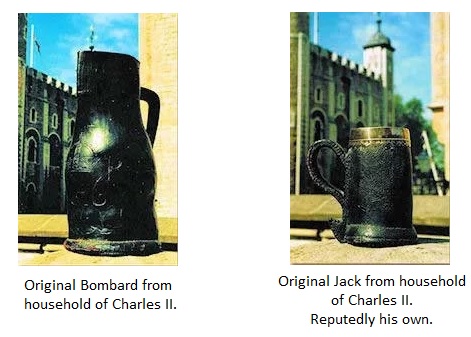
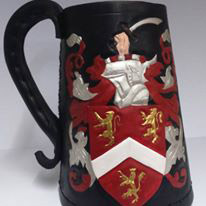
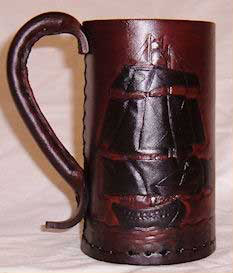
The history of leather drinking vessels stretches from early medieval jacks, through, later Tudor tankards, goblets, bombards, goblets and the late 19/20th Century jacks simplified cylindrical shape and is a very British history.
Moulded leather vessels may date back to early Egyptian times when some pottery forms followed the shape and style of skin bags. A relief on the Rekhmire Tomb clearly resembles a leather bottle. An early Nubian pre-dynastic grave has revealed a leather vessel at the head of the occupant where a pottery one would normally be expected. Pan graves of 1600 BC att Mostagedda contain solid forms of the shape of clay pots which may represent cores for shaping such leather vessels.
Moving to western Europe, Neolithic leather beakers and a small bowl were found in Schleswig, Switzerland and a Neolithic beaker was found at West Smithfield, London, made of tanned cowhide with some hair still attached, Neolithic pottery suggests an origin in leather bowls with bag like shapes and seams being reproduced.
Britain has been the home of leather vessels for longer and in higher numbers than anywhere else in history and their existence has become quintessentially British. The first design was the early medieval jack, followed by the Tudor tankard which had a wider base for use on board ship, During the Rennaisance, leather wine goblets were in common use from nobility to the man in the street. This was followed by a later cylindrical jack shape to purposely allow manufacturing costs to drop to a more achievable level.
In the North of England late period jacks were used in coal mines where much water was needed to slake the dusty throats of the miners. They had bells attached to the bottom of the handle so that the water boy could be called when needed. They were known as Jingle Boys.
Also used in iron foundries in the midlands, later period jacks had a whistle set into the bottom of the handle so that the water boy could be called when needed. In this case they were known as Piggins which is where the west country pub name The Pig and Whistle originates.
In 1848, near Buxton, a leather cup with a silver lip was found in a Saxon Barrow. In the manuscript entitled “Colloquy of Archbishop Alfric” are comments attributed to a “shoe-wright” in which he describes the articles he makes including “shoes, ankle-leathers, and bottles, bridle-thongs, flasks and bougets”
The bouget was a pair of waterproof leather bags joined by the kneck and may correctly be referred to as a drinking vessel. Introduced in to England during the Crusades, it was the fore-runner of the hard bodied leather water bottle.
The Black Jack`s name is derived from the materials used in its construction. Leather that has been soaked in hot water and dried is known as Jack leather. The same source can be attributed to the name for German Jackboots and Medieval Arming Jacks. This is also the origin of the modern word “jacket“. Jacks were originally black because the black material used to line the inside, was used on the outside of the vessel thus colouring it. For a description of the materials we use, see Factsheet Page.
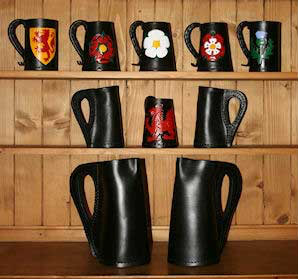
In the 13th Century the Guild of Cordwainers was established to supervise the tanning and currying of leather. Specialisation continued and in the early 14th Century the Company of Botellars or Bottle- Makers, was established. Early ordinances of the Guild show that leather vessel making had been officially recognised from early times, recording in 1373 that the
“mistery of botellars had been well and in order made from the time whereof memory does not run the contrary”.
We at Hidebound are pleased to follow the Guild ordnance that every bottle and Jack maker
“should put his mark on the vessels he made that they might be identified”.
Botellars also made pots. This shows that the word “pottery” is derived from the craft of leather working and not from those who are now known as potters. “Pot” comes from the term “potable water” being liquid which pots carry whether they were made of pottery or leather.
Laws were passed by various Monarchs from Edward II to Elizabeth I which placed high export tarrifs on leather. This resulted in a drastic reduction in price in England and so made it the material of choice for drinking vessels. Leather was also the material of choice for the transportation of liquids around the country because its light weight compared well with that of the alternative, earthenware.
Leather workers of all types were understandably happy with lower prices resulting in the popular ballad of the time “The Shoe-Makers Delight”. However, not all were pleased because in the reign of Charles II export taxes had a disastrous effect on associated cattle rearing and land prices. The duties were eventually revised, thus raising leather prices and reducing its use for such as drinking vessels. It seems that such distortion of the markets is no new thing.
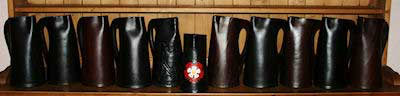
The history of the leather bottle, black jack and tankards continued through various fashion changes, including the widening of the base for stability in Tudor times, as shown by those found with the wreck of the Mary Rose, so we are left with a multitude of shapes to represent the various periods.
Tankards and Jacks took their place in the literature of the day as found in the adventures of Mr Pickwick at the Leather Bottle in Cobham. It is fit that inns were named after leather vessels because they did attract an air of convivial association as shown in the old drinking song “The leather Bottle”.
Black Jacks and bombards were unknown in France. A French courtier returning to his country from the court of Charles II, reported that the English drank from their boots. This phrase was revived during the Battle Trafalgar when English sailors were ridiculed for the same thing.
In the village of Hallaton, Northamptonshire, the sport of bottle kicking was very popular. More recently made of wood, the bottle was originally made of leather making one wonder if this was the origin of the leather football.
 |
 |
 |
During Elizabethan times, even wealthy merchant families would possess just one wine glass because of the high cost of Venetian glass. Placed in the middle of the table and used communally, it would be refilled by a man stood in the corner with a leather bottle and known as the botellar or, in modern terms, the butler.
Leather drinking vessels are closely associated with the social history of the country and their use continues to the present day.